Goldman Sachs Predicts 11% Global Equity Returns in 2026: What Does It Mean for Crypto?
Goldman Sachs has forecasted that global equities will continue to rise in 2026, projecting an 11% return, including dividends, over the next 12 months. The rally will be supported by earnings growth and broad economic expansion.
As traditional markets continue to climb, a critical question comes into focus: will digital assets move in step with equities, or will they follow a distinct trajectory of their own?
Goldman Sachs Shares 2026 Forecast for Global Equities
Goldman Sachs’ 2026 global equity outlook points to further upside for major indices. According to the report, the global economy is expected to expand across all regions next year, with global GDP projected to grow by 2.8%.
The US Federal Reserve is also forecast to deliver additional modest policy easing this year, reinforcing a favorable macroeconomic backdrop. Against this, Peter Oppenheimer, Goldman Sachs Research’s chief global equity strategist, suggests that a major equity downturn remains unlikely in the absence of a recession.
“We think that returns in 2026 are likely to be driven more by fundamental profit growth rather than by rising valuations. Our analysts’ 12-month global forecasts indicate equity prices, weighted by regional market cap, are expected to climb 9% and return 11% with dividends, in US dollars (as of January 6, 2026). Most of these returns are earnings-driven,” Oppenheimer wrote.
That said, the firm added that equity gains in 2026 are unlikely to replicate the sharp rally seen in 2025. This signals a more measured pace of returns ahead.
“While stocks performed strongly in 2025…the gains didn’t happen in a straight line. Equities underperformed early in the year, with the S&P 500 undergoing a correction of almost 20% between the middle of February and April, before rebounding. The strong rally in global equities has left valuations at historically high levels across all regions—not just in the US but also in Japan, Europe, and emerging markets,” the report reads.
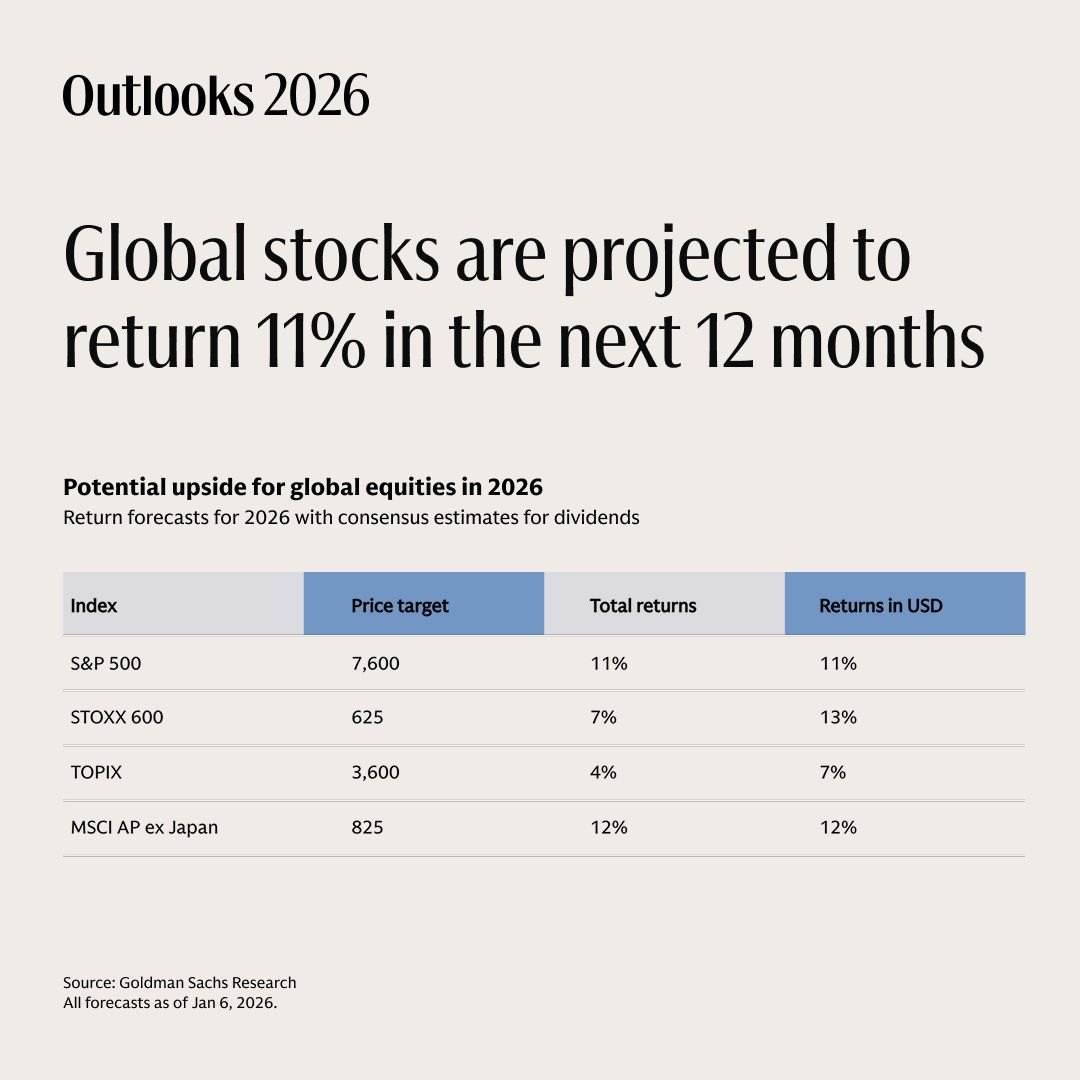
The report revealed targets of 7,600 for the S&P 500 (implying an 11% total return), 625 for the STOXX 600 (7% return), 3,600 for Japan’s TOPIX (4% return), and 825 for the MSCI Asia Pacific ex-Japan (12% return).
The analysis suggests that stocks are currently in the optimism phase of the market cycle. This began with the bear market that occurred during the COVID-19 pandemic in 2020. According to the team, this late-cycle optimism phase is typically associated with rising valuations, indicating potential upside risks to their central forecasts.
The report also addressed growing attention toward AI-related stocks. Analysts noted that the market’s focus on artificial intelligence remains strong, but stressed that this does not necessarily indicate the presence of an AI bubble.
Is Bitcoin Still Correlated With the S&P 500 in Early 2026?
While traditional equities enter 2026 with expectations of continued growth, attention is shifting to how the crypto market will perform. Bitcoin, the largest cryptocurrency, has generally exhibited a positive correlation with the S&P 500, although it has also experienced periods of clear independence.
Examining data from the past year, CryptoQuant revealed that BTC’s correlation with the S&P 500 remained largely positive. However, the correlation briefly turned negative between September and October, again in November, and twice in December.
“In H2 2025, Bitcoin’s correlation with the S&P 500 fell sharply. This was not a temporary divergence, but a result of structural changes in market behavior,” an analyst noted.
The analyst attributed this to several factors:
- Spot Bitcoin ETFs shifted demand from short-term trading to allocation-driven inflows.
- Leverage risks declined as derivatives markets reduced high BTC-margined exposure.
- Macro liquidity rotated toward commodities and precious metals, bypassing crypto.
- Short-term, equity-linked traders exited the market, leaving a base of long-term holders.
- Bitcoin price action became more influenced by internal supply dynamics than equity market sentiment.
According to the latest data from CryptoQuant, the correlation has turned negative again, currently standing at -0.02 at the time of writing. This suggests that in early 2026, Bitcoin is not trading as a risk-on equity proxy.
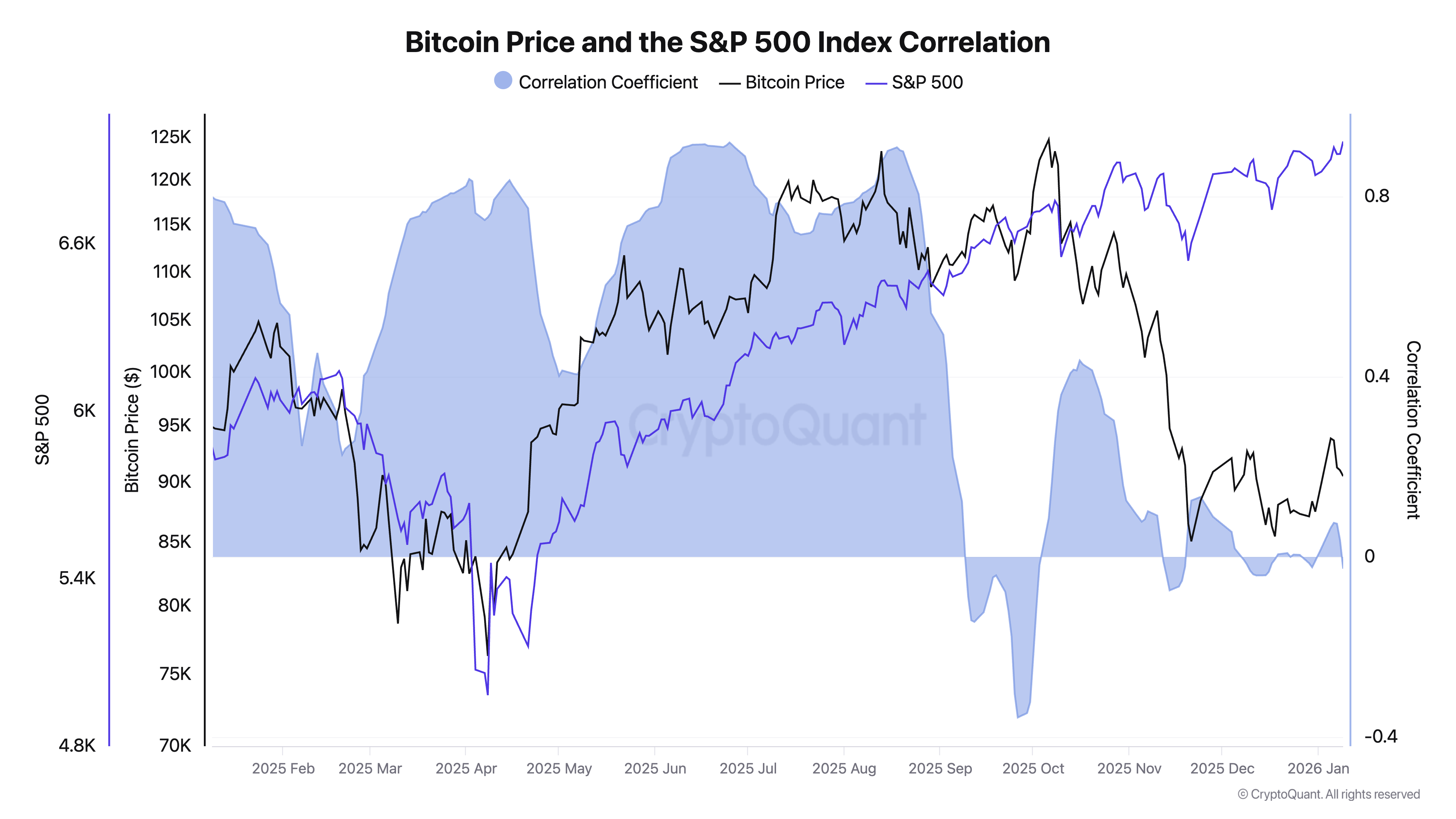
Still, correlation regimes have proven unstable in past cycles, leaving open the possibility of a renewed alignment with equities. In such a scenario, a sustained equity rally could once again act as a tailwind for Bitcoin, allowing it to benefit from broader risk-on sentiment.
The post Goldman Sachs Predicts 11% Global Equity Returns in 2026: What Does It Mean for Crypto? appeared first on BeInCrypto.
Read moreLatest News