Fan Tokens and the Road to 2026: Assessing the Opportunity
As crypto enters a more mature phase, attention is shifting from broad narratives to sectors with clear use cases and identifiable catalysts. Within this context, SportFi, and Fan Tokens in particular, has emerged as a consumer-facing vertical that links real-world events, global fan engagement, and on-chain markets. This article examines how Fan Tokens have evolved, why they exhibit unique market dynamics, and why recent industry developments and upcoming catalysts position them for a potentially significant 2026.
From Crypto Adoption to SportFi: Key Developments Through 2025
Crypto has evolved from a niche, retail-driven and highly volatile experiment into a more institutionalized and regulated asset class with growing global adoption. In its early years (2009–2019), usage was largely speculative, driven by Bitcoin’s emergence as a peer-to-peer system and later by the rise of altcoins such as Ethereum. Adoption was limited, volatility was extreme, and participation was concentrated among early adopters with relatively small holdings.
Since 2020, several developments have accelerated crypto’s mainstream acceptance. The expansion of DeFi and NFTs demonstrated new on-chain use cases, while corporate balance-sheet adoption and growing retail participation increased market depth. More recently, the approval of spot Bitcoin ETFs in the U.S., the rapid growth of stablecoins as payment and settlement tools, and clearer regulatory frameworks, such as the EU’s MiCA, have lowered barriers for institutional and traditional investors. Together, these shifts signal a transition toward broader integration of crypto within the global financial system, beyond pure speculation.
By 2025, the total crypto market capitalization surpassed $4 trillion for the first time, representing a roughly 21x increase from about $190 billion in 2020. Data from a16zcrypto also show continued growth in user activity, with crypto mobile wallet users reaching all-time highs, up 20% year over year. Estimates suggest around 40–70 million active crypto users globally, roughly 10 million more than last year, compared with an estimated 716 million people who own crypto, a figure that grew 16% year over year.
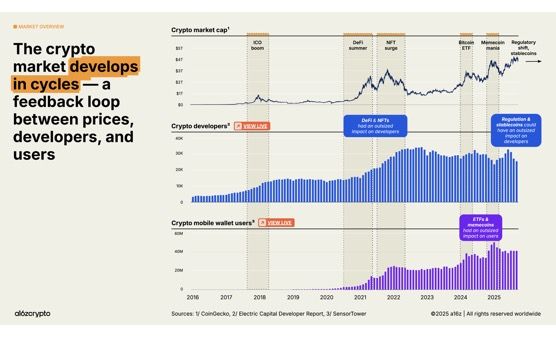
Source: a16zcrypto.
Within the broader crypto ecosystem, multiple sectors have expanded alongside increasing adoption, including Layer 1 networks, stablecoins, DeFi, GameFi, and, more recently, SportFi, with Fan Tokens representing its most established and widely adopted use case.
First introduced in 2019 by major football clubs such as Juventus and Paris Saint-Germain, over time, the sector has matured from a small experimental niche into a structured market adopted by close to 100 sports organizations across football, esports, motorsports, and combat sports. Clubs use Fan Tokens as a digital engagement and monetization layer, offering holders access to governance polls, rewards, and experiences, while benefiting from recurring revenues and deeper global fan interaction.
From an adoption perspective, Fan Tokens mirror the role GameFi played earlier in the decade: acting as a gateway for users who may not otherwise engage with crypto. Sports, particularly football, with an estimated global fanbase exceeding 3 billion people, provide a familiar and culturally embedded entry point. As crypto adoption continues to be driven top-down by institutions and bottom-up by consumer-facing applications, Fan Tokens stand out as one of the more promising consumer crypto verticals, combining recognizable brands, clear utility, and a large addressable audience.
Key Characteristics of Fan Tokens
Fan Tokens exhibit dynamics that set them apart from most crypto assets. Their price action is often driven by major sporting events and fan engagement, which can cause them to decouple from Bitcoin and broader market cycles. In these periods, performance and anticipation around a club tend to matter more than macro crypto sentiment.
This is supported by their underlying structure: each Fan Token is tied to a real-world sports franchise with a long operating history and an established global fan base. As a result, Fan Tokens offer a form of event-driven exposure that can provide diversification relative to traditional crypto narratives.
This event-driven behavior is visible in practice. For instance, during Tottenham’s Europa League 2025 run, rising expectations after the quarter-final win led $SPURS to rally sharply and decouple from the broader crypto market, gaining +83% versus $BTC’s +13%. A similar dynamic emerged with Paris Saint-Germain in the 2025 Champions League, where advancement to the semi-finals drove $PSG to +40% compared to $BTC’s +17%, reflecting football-specific sentiment rather than market beta.
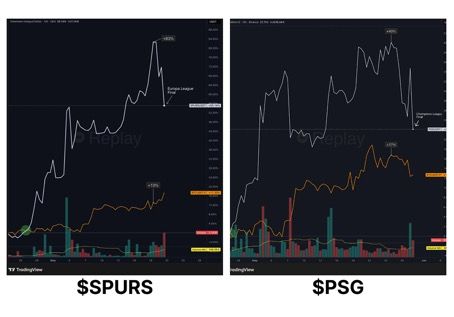
Source: TradingView
A more recent example is Arsenal’s 10-match winning streak across the Premier League and Champions League between late September and mid-November. Following the October crypto sell-off, $AFC diverged from broader benchmarks, gaining over 30% from the October 11 market low. Over the same period, $CHZ rose about 19%, while $TOTAL3 and $BTC declined by 2.4% and 7.6%, respectively, with Arsenal’s on-field performance acting as the primary driver of $AFC price action.
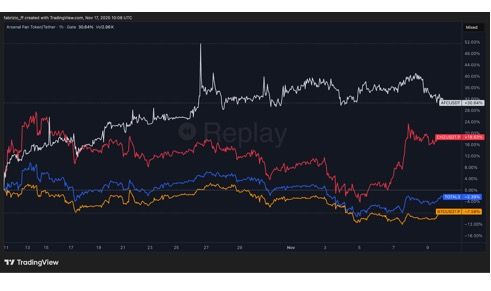
Source: TradingView.
These examples highlight a core feature of Fan Tokens: their prices are driven by sporting momentum and expectations rather than broader crypto conditions. While their pricing is still influenced by macro trends, real-world outcomes, momentum, and fan expectations can trigger periods of decorrelation and independent price discovery.
As confidence around a club increases, Fan Tokens become a way to express views on future performance, functioning similarly to continuous, liquid prediction markets. Unlike traditional sportsbook bets, positions can be adjusted in real time, allowing traders to gain or reduce exposure as sentiment evolves.
This dynamic aligns with the rapid growth of on-chain prediction markets, where users increasingly speculate on real-world outcomes, including sports. After breaking into the mainstream during the 2024 U.S. election cycle, platforms such as Polymarket and Kalshi have continued to expand, with trading volumes rising nearly 5x since the start of 2025 and approaching prior peaks.
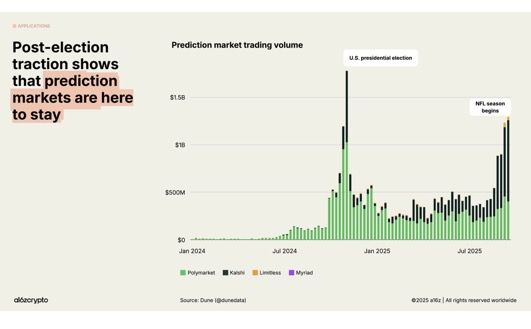
Source: a16zcrypto.
As this behavior scales beyond elections, it is likely to reinforce demand and liquidity for Fan Tokens, which similarly adjust in real time to changes in performance, expectations, and collective belief.
Chiliz’s Role in the SportFi Evolution
Recent developments indicate that Fan Tokens are entering a new phase of expansion, with Chiliz strengthening the infrastructure, regulatory footing, and real-world integrations needed to support broader adoption into 2026.
In December 2025, Chiliz Chain powered the launch of Decentral, the first RWA protocol focused on financing football media rights. This marked a concrete step into on-chain sports finance, addressing a real liquidity problem faced by clubs by enabling broadcast receivables and sponsorship cash flows to be financed through decentralized markets. The move aligns closely with the broader industry shift toward tokenized real-world assets, a theme highlighted by a16z, BlackRock, and regulators alike, with the RWA market already reaching roughly $30 billion, up nearly 4x in the last two years.
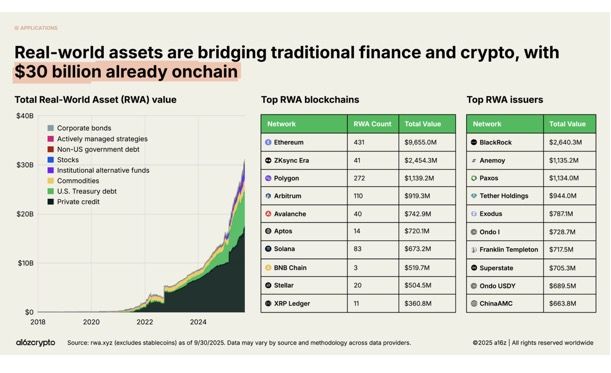
Source: a16zcrypto.
At the same time, Chiliz has been building the regulatory and institutional foundations required for this evolution. In 2025, Socios Europe Services became the first sports-focused platform authorised under the EU’s MiCA framework, granting regulated access to Fan Tokens across all 27 EU countries and providing a compliant gateway for future tokenized sports assets. Strategic partnerships, such as the alliance with Assetera, further reinforce this direction by enabling fully regulated, investment-grade sports RWAs, including revenue-linked instruments and other structured products.
Together, these developments signal that Chiliz is not only following industry trends like tokenization and RWAs, but actively shaping a regulated SportFi stack that connects fan engagement, real-world sports economics, and on-chain finance.
Fan Tokens Ahead of 2026
Looking ahead to 2026, the FIFA World Cup represents a powerful catalyst for Fan Tokens beyond recent developments. With the tournament starting in June 2026, Google Trends already shows rising global interest for an event that engaged roughly 5 billion people in 2022.
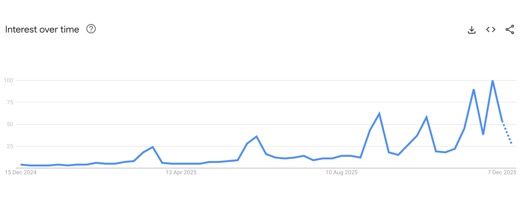
Source: Google Trends. Search term: “world cup 2026”, past 12 months.
As attention builds, activity is likely to spill over into speculative venues such as traditional sportsbooks and on-chain prediction markets, and, by extension, into Fan Tokens, which offer a liquid, real-time way to express expectations around team performance.
Several months ago, we explored gaining exposure to the SportFi narrative through a Fan Token Index, designed to provide diversified exposure without relying on a single club. The index allocated 50% to $CHZ as the core proxy for the ecosystem, with the remaining 50% equally weighted across selected football Fan Tokens tied to clubs with strong recent performance or major upcoming catalysts, including $ARG, $PSG, $BAR, $NAP, $GAL, and $JUV.
From the end of July to today, the Fan Token Index has declined by 32%, only modestly underperforming $BTC’s −25.4% despite the significant differences in maturity and liquidity. Importantly, the index exhibited lower volatility than most of its constituents, with annualized volatility of 12.7% versus 8.3% for $BTC, while individual Fan Tokens recorded losses between −22.7% and −52% and volatilities ranging from 9.4% to 35%. This highlights the diversification benefits of an indexed approach.
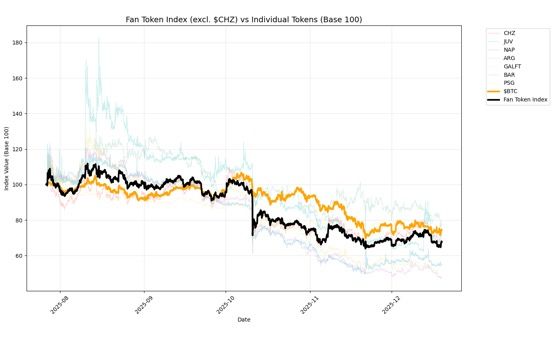
Source: TradingView (price data), author’s analysis (portfolio construction). As of December 19, 2025.
With a total market capitalization of roughly $240 million, Fan Tokens remain a very small segment of the crypto market compared to the ~$3 trillion total crypto market cap and categories such as GameFi, valued at about $6.1 billion. This gap highlights the potential for further growth, especially given the sector’s relative resilience to recent market stress, including the October liquidation event. As such, Fan Tokens may represent a complementary allocation within a diversified crypto portfolio.
Looking ahead to 2026, a diversified Fan Token Index appears more attractive than single-name exposure. The market is more mature than in prior cycles, and the 2026 World Cup is likely to act as a major speculative catalyst. Historical evidence from the 2022 World Cup suggests that Fan Tokens tend to appreciate in the months leading up to the tournament due to anticipation, followed by weaker performance as matches begin, consistent with a “buy the rumor, sell the news” dynamic. This implies potential asymmetry in the pre-event phase, while also highlighting the importance of actively managing exposure as the event approaches.
Conclusion
Fan Tokens sit at the intersection of sport, finance, and on-chain markets, offering exposure that is structurally different from most crypto assets. With a still-small market size, improving infrastructure, clearer regulation, and major global sporting events ahead, the conditions are in place for increased participation and liquidity. While outcomes remain event-driven and timing matters, the combination of maturing market structure and powerful real-world catalysts makes Fan Tokens an increasingly relevant segment to watch as SportFi develops into 2026.
References
A Fan Token Index for World Cup 2026 and Beyond. BeInCrypto (July, 2025) | Link
Anticipatory Gains and Event-Driven Losses in Blockchain-Based Fan Tokens: Evidence from the FIFA World Cup. SSRN (March, 2024) | Link
Big Ideas 2026. A16Z (December, 2025) | Link
Chiliz and Assetera join forces to accelerate tokenized Real-World Assets in sports and entertainment. Chiliz Blog (November, 2025) | Link
Decentral launches first football media-rights RWA pool on Chiliz Chain, marking a new chapter for SportFi. Chiliz Blog (December, 2025) | Link
Evaluating the Fan Token Index After Its First Month. BeInCrypto (September, 2025) | Link
FanTokens | Link
From Wall Street to the World Cup: How Football Became Crypto’s Biggest Gateway Drug. CoinDesk (December, 2025) | Link
How Fan Tokens Are Powering Global Fan Communities. Fan Tokens (October, 2025) | Link
Pricing Belief: $AFC and the Emergence of Prediction Dynamics in Fan Tokens. BeInCrypto (November, 2025) | Link
SportFi: Technical and Fundamental Analysis Of The Chiliz And Fan Token Ecosystem. BeInCrypto (May, 2025) | Link
State of Crypto 2025: The year crypto went mainstream. a16zcrypto (October, 2025) | Link
The Chiliz Chain in 2025: From Fan Tokens to a Sovereign Stadium. Chiliz Blog (December, 2025) | Link
The Chiliz Group celebrates dual MiCA milestone: European licence for Socios Europe Services and MiCA-compliant CHZ white paper. Chiliz Blog (December, 2025) | Link
The Evolution of Cryptocurrency Markets: An Empirical Study from 2017 to 2025. Northwestern Edu (July, 2025) | Link
Why Fan Tokens Are More Than Just Another Crypto Asset. Fan Tokens (July, 2025) | Link
The post Fan Tokens and the Road to 2026: Assessing the Opportunity appeared first on BeInCrypto.
Read moreLatest News