What Crypto Whales Are Buying and Selling During the US-Iran Conflict
As the US-Iran conflict shakes global markets, crypto whales are not reacting with simple panic or blind optimism. They are rotating. On-chain data shows crypto whales both buying and selling with precision, positioning for volatility rather than direction.
Some tokens are being accumulated quietly, others dumped into strength. BeInCrypto analysts have identified three tokens where whales are actively positioning — offering potential long and short setups for traders watching closely.
Buying: The White Whale (WHITEWHALE)
During the US-Iran conflict volatility, crypto whales buying The White Whale (WHITEWHALE) stands out as a selective move. While the broader crypto market reacted sharply to war headlines, whale wallets increased their WHITEWHALE holdings by 3.59% in the past 24 hours. The total stash now sits at 14.07 million tokens. That means roughly 487,000 WHITEWHALE were added in a single day.
Want more token insights like this? Sign up for Editor Harsh Notariya’s Daily Crypto Newsletter here.

On the 12-hour chart, the structure is still bearish. A clear head-and-shoulders pattern is visible. That usually signals more downside, almost 60% per projection if the neckline cracks. But one key indicator may explain why crypto whales are buying despite that risk.
The Smart Money Index, which tracks the positioning of informed, alpha-seeking traders, began moving toward its signal line on February 28, right as the US-Iran conflict escalated. A similar move happened on January 25. Back then, the Smart Money Index crossed above the signal line, and WHITEWHALE rallied about 221%.
On March 3, a fresh crossover surfaced. It is early and needs follow-through, but whales may be positioning ahead of confirmation. WHITEWHALE trades near $0.048, up about 14% in 24 hours. For a stronger rally, the price must break $0.058 and then $0.069. Only a move above $0.107 weakens the bearish setup. Full invalidation sits near $0.153, which looks unlikely for now.
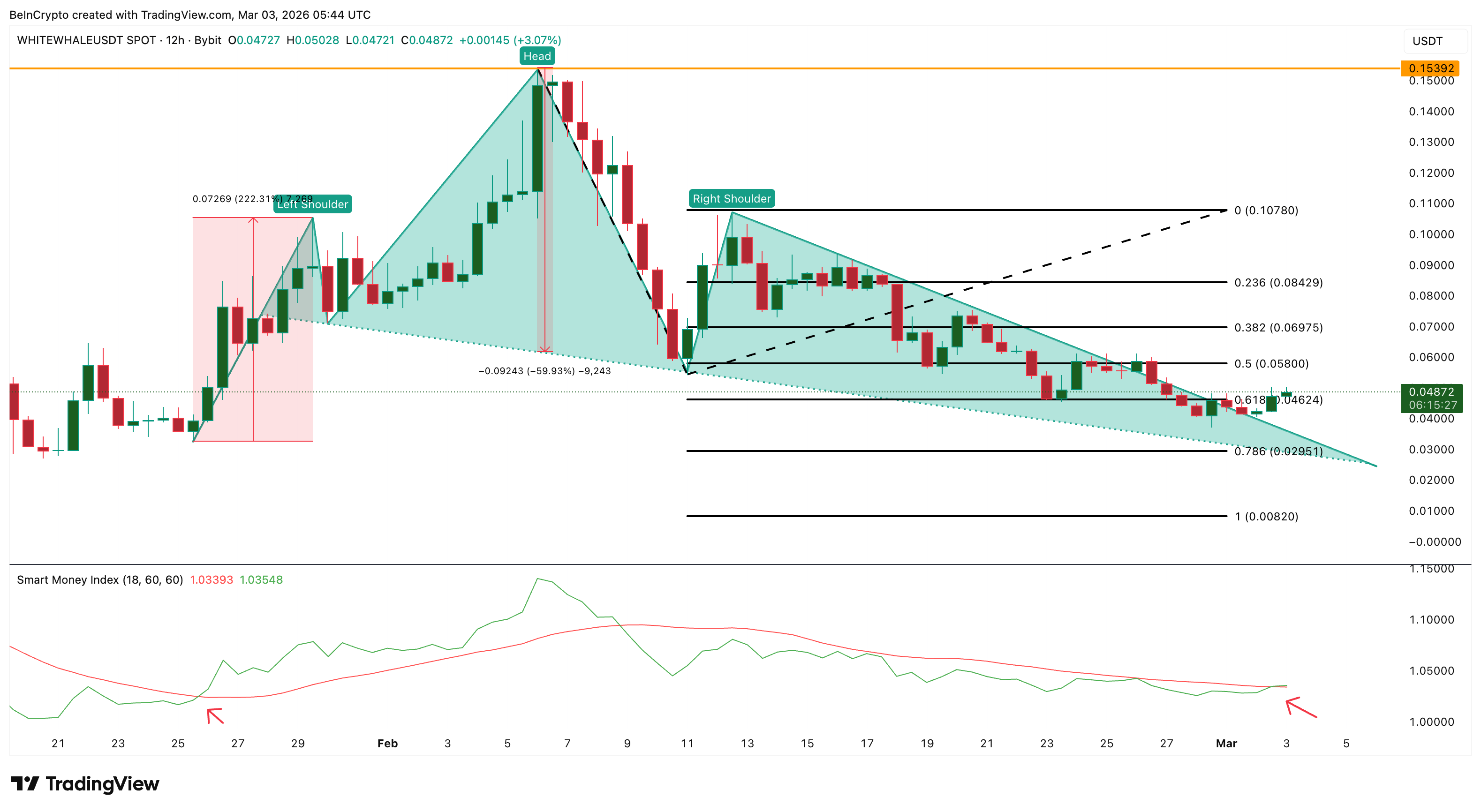
So in this US-Iran conflict phase, crypto whales buying The White Whale seems tied to smart money signals, not the war buzz. But then, the downside risks remain as the pattern itself is bearish. If smart money starts dumping and WHITEWHALE breaks under $0.029, it would trigger a pattern breakdown. That might lead to whale-driven selloffs and opening of lower levels.
Selling: WAR (WAR)
If crypto whales buying The White Whale reflects selective positioning during the US-Iran conflict, then crypto whales selling WAR shows the opposite side of that rotation. It is hard to ignore the irony. A Solana-based token named WAR is up over 40% in the past 24 hours and nearly 54% over the past seven days, right as real-world war headlines dominate markets.
But whales are not chasing it higher. They are exiting.
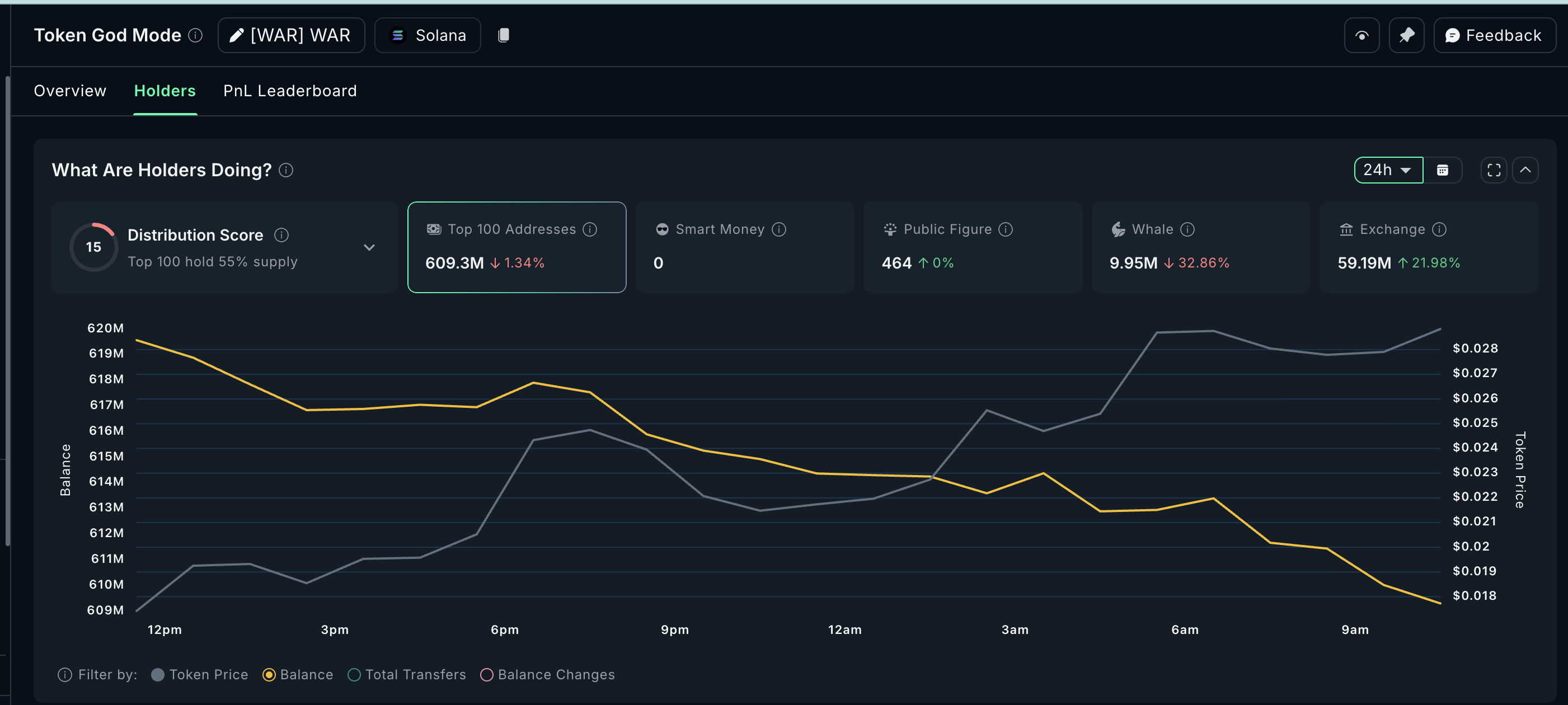
On-chain data shows WAR whales cut their holdings by 32.86% in just 24 hours. Their current stash sits at 9.95 million tokens. That means roughly 4.86 million WAR were offloaded in a single day. Even the top 100 addresses reduced their holdings by 1.34%, a clear sign that large players are trimming exposure into strength.
Technically, the hourly chart is flashing warning signs. Between two candles on March 2, the price printed higher highs while the Relative Strength Index printed lower highs. RSI measures momentum on a scale of 0 to 100. When price rises, but RSI falls, that is bearish divergence. It often signals that buying strength is fading. That could lead to a short-term trend reversal, from bullish to bearish, explaining the whale selling.
WAR now needs a strong hourly close above $0.030 to extend the rally toward $0.034. If $0.026 support breaks (currently holding strong), the next major level sits near $0.020. That would represent roughly a 27% drop from current levels.
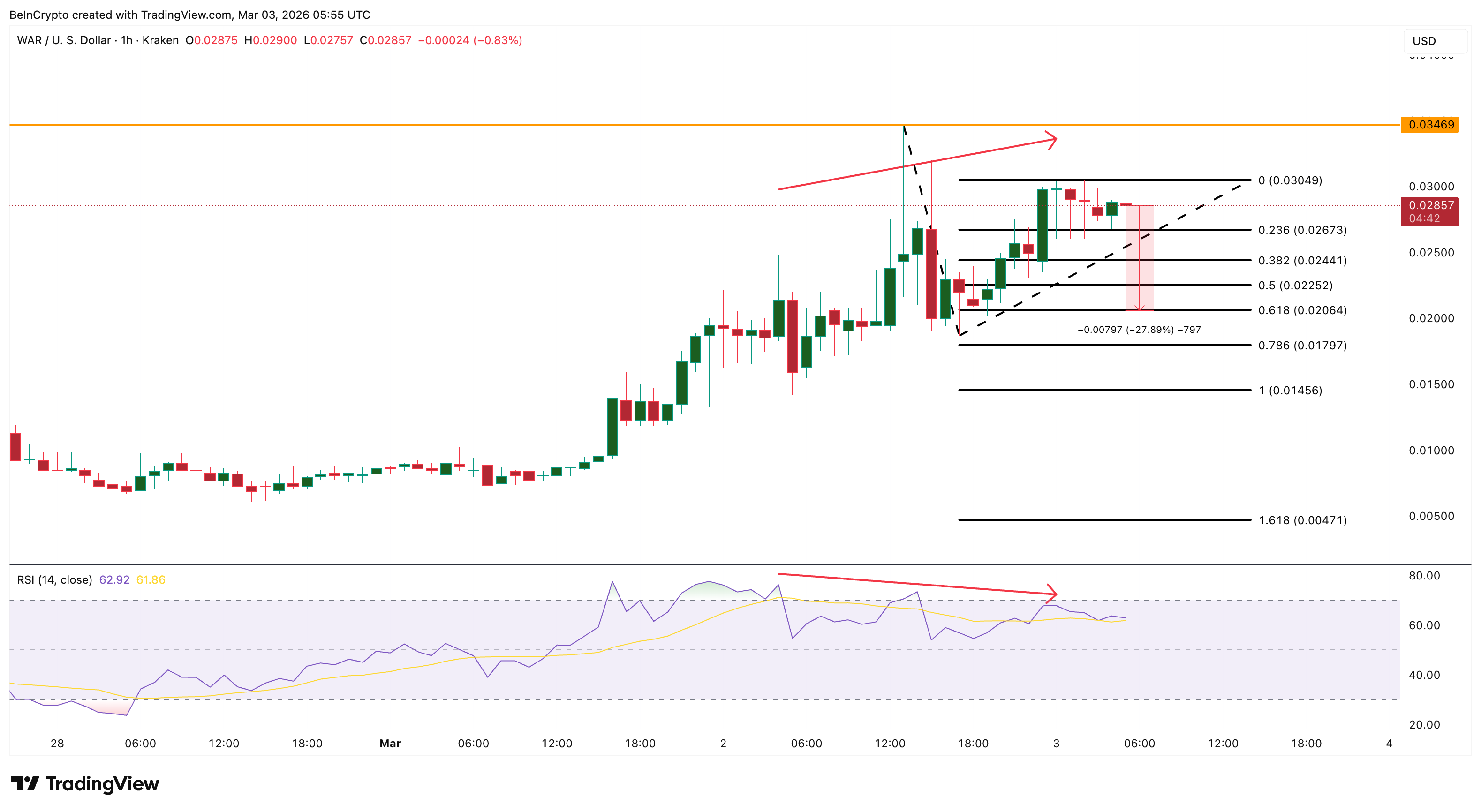
With crypto whales selling during the US-Iran conflict and bearish divergence in play, the lower path currently looks more probable than another explosive move higher.
Selling: Uniswap (UNI)
Crypto whales selling Uniswap (UNI) during the US-Iran conflict is the most ironic move of all.
DeFi has been one of the stronger sectors.
Uniswap just secured a major legal win.
The cup-and-handle structure on the daily chart still projects a larger breakout toward $6.18 if confirmed. Yet whales have been trimming.
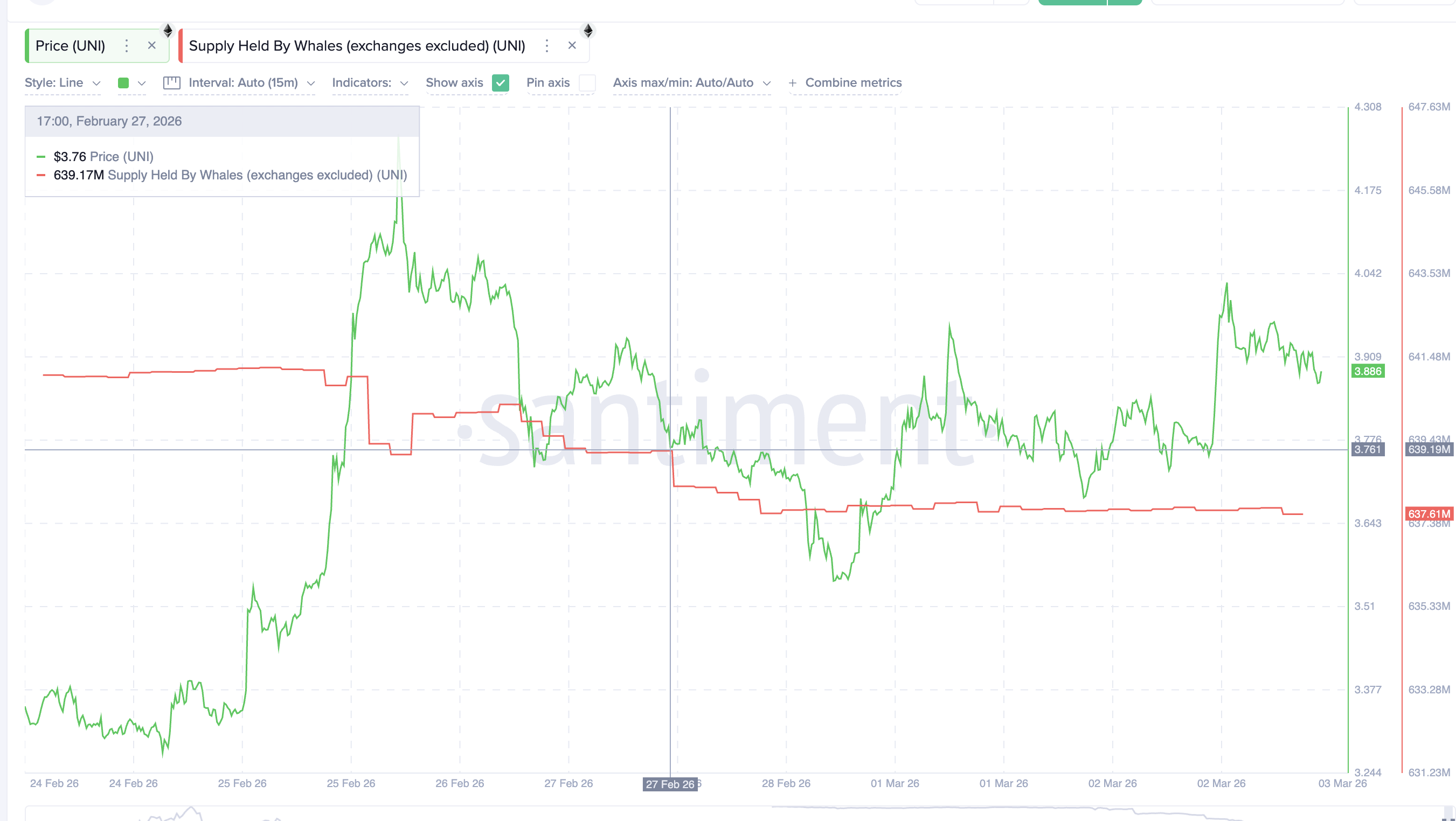
Supply held by whales (excluding exchanges) dropped from 639.19 million UNI on February 27 to 637.61 million now. That is a reduction of 1.58 million UNI. At the current price, that equals roughly $6.1 million worth of tokens offloaded. The selling began right before the full escalation of the US-Iran conflict, suggesting positioning, not panic. However, whales have even dropped some part of their stash today, despite the bullish legal news.
Technically, UNI formed a cup and handle, but the handle consolidation that started around February 25 is stretching longer than expected. Between January 28 and March 2, the price printed a lower high while the Relative Strength Index printed a higher high. When RSI rises while price fails to make higher highs in a broader downtrend, that forms hidden bearish divergence. It often leads to short-term pullbacks.
UNI must reclaim $4.40, the 0.618 Fibonacci level, to confirm strength. Above that, $4.99, $5.89, and $6.18 come into play. But if price slips toward $3.53, the pattern weakens. A breakdown below $2.83 would invalidate the structure.
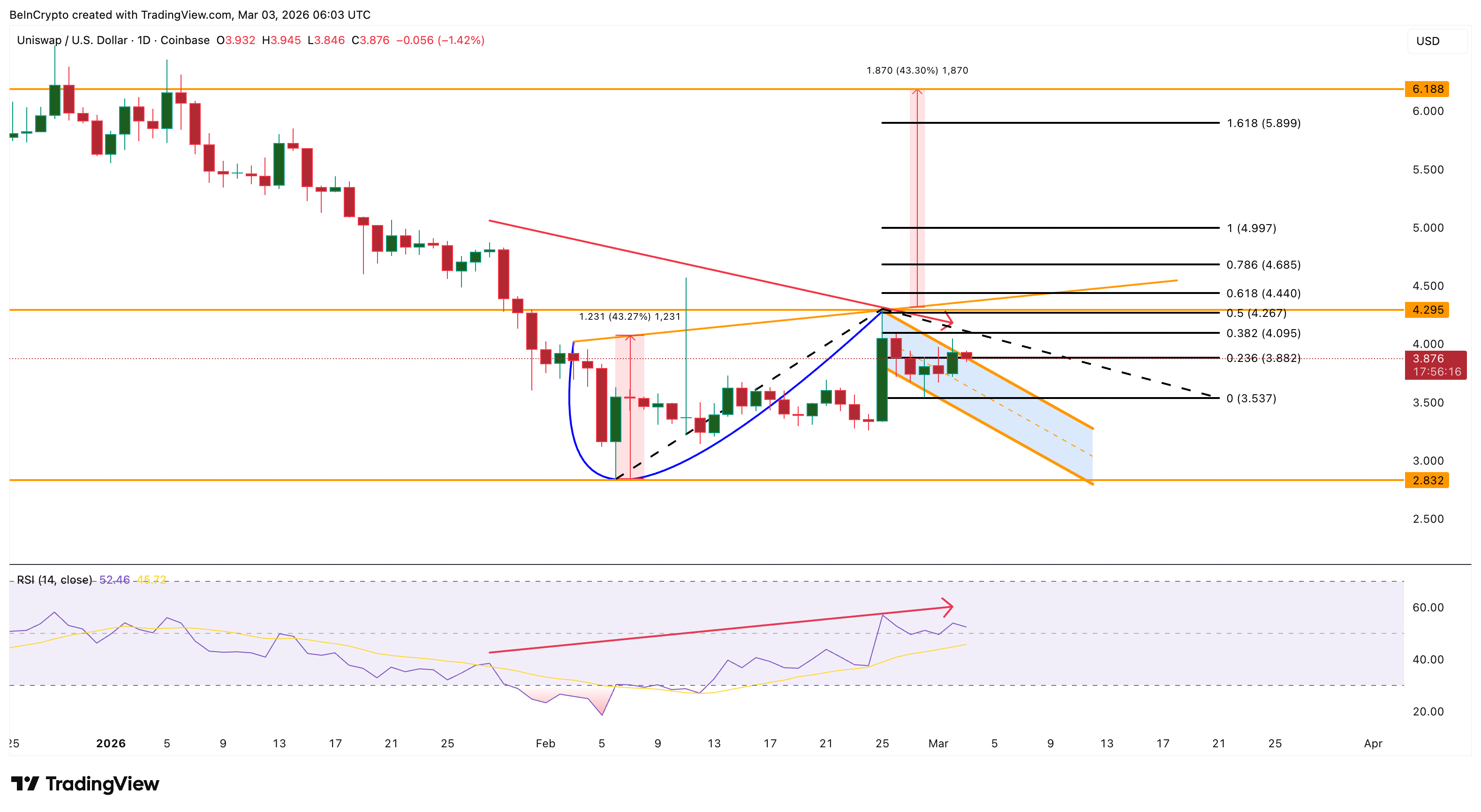
With crypto whales selling during the US-Iran conflict despite positive fundamentals, this could signal that the recent DeFi rotation was short-term positioning, not long-term conviction.
The post What Crypto Whales Are Buying and Selling During the US-Iran Conflict appeared first on BeInCrypto.
Read moreLatest News