3 Crypto Futures Trading Mistakes That 2025 Brutally Exposed
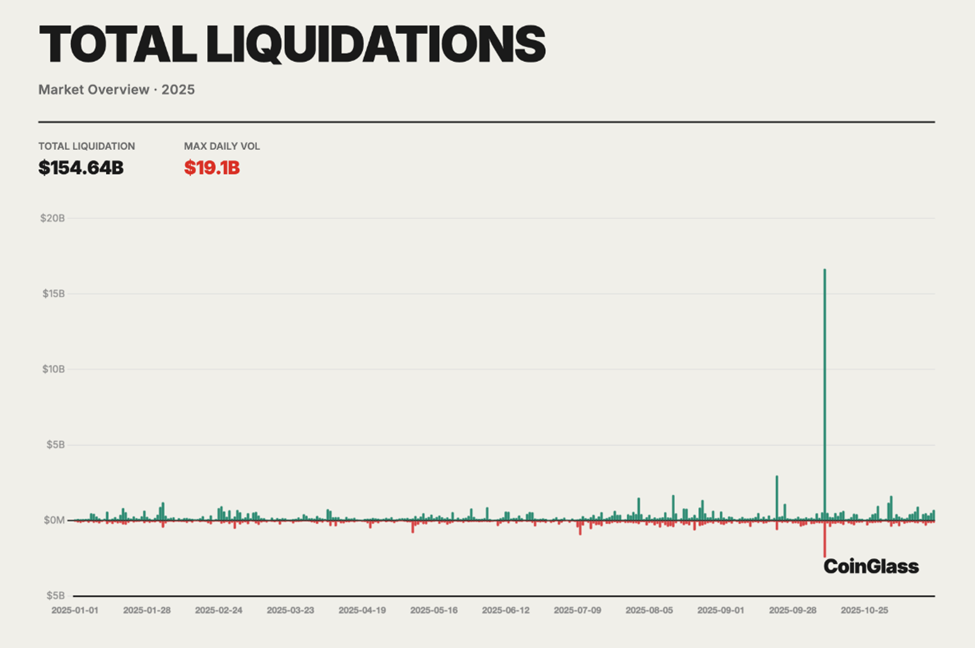
The year 2025 will be remembered as the moment crypto futures trading stopped being a theoretical risk and became a measurable systemic failure. By year’s end, more than $154 billion in forced liquidations had been recorded across perpetual futures markets, according to aggregated data from Coinglass, translating to an average of $400–500 million in daily losses.
What unfolded across centralized and decentralized derivatives venues was not a single black swan event, but a slow-motion structural unwind.
Why Perpetual Futures Became Liquidation Engines in 2025
The scale was unprecedented, with Coinglass’ 2025 crypto derivatives market annual report showing $154.64 billion in total liquidations for the past year.
Yet the mechanics behind the losses were neither new nor unpredictable. Throughout the year, leverage ratios increased, funding rates issued persistent warnings, and exchange-level risk mechanisms proved to be deeply flawed under stress.
Retail traders, drawn in by the promise of amplified gains, absorbed the bulk of the damage.
The breaking point arrived on October 10–11, when a violent market reversal liquidated over $19 billion in positions within 24 hours, the largest single liquidation event in crypto history.
Long positions were disproportionately affected, accounting for an estimated 80–90% of liquidations, as cascading margin calls overwhelmed order books and insurance funds alike.
Drawing from on-chain analytics, derivatives data, and real-time trader commentary on Twitter (now X), three core mistakes stand out. Each contributed directly to the magnitude of losses witnessed in 2025, and each carries critical lessons for 2026.
Mistake 1: Over-Reliance on Extreme Leverage
Leverage was the primary accelerant behind 2025’s liquidation crisis and arguably the leading crypto futures trading mistake. While futures markets are designed to enhance capital efficiency, the scale of leverage deployed throughout the year crossed from strategic to destabilizing.
CryptoQuant data indicates that the Bitcoin Estimated Leverage Ratio reached a record high in early October, just days before the market’s collapse.
At the same time, total futures open interest exceeded $220 billion, reflecting a market saturated with borrowed exposure.
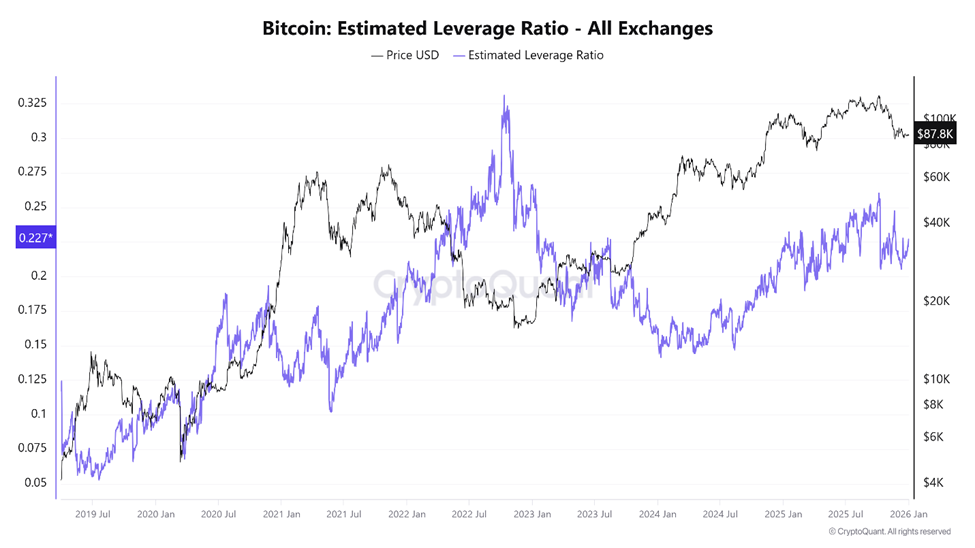
On major centralized exchanges, estimated leverage ratios for BTC and ETH frequently surpassed 10x, with a meaningful portion of retail traders operating at 50x or even 100x.
“High-leverage trading can be a double-edged sword…It offers a tantalizing opportunity for profit, but… can lead to some pretty devastating losses,” OneSafe analysis noted.
Coinglass data from late 2025 illustrated the fragility of this structure. While the long-to-short ratio remained near equilibrium (approximately 50.33% long versus 49.67% short), a sudden price move triggered a 97.88% surge in 24-hour liquidations, reaching $230 million in a single session.
Balanced positioning did not equate to stability. Instead, it meant both sides were equally overextended.
During the October crash, liquidation data revealed a brutal asymmetry. Long positions were systematically wiped out as price declines forced market sells, pushing prices lower and liquidating the next tier of leverage.
“In 2025, the casino side of crypto finally showed its true cost. More than $150B in forced liquidations vaporized leveraged futures positions… Most people are not trading anymore; they are feeding liquidation engines,” remarked one crypto researcher.
This was not hyperbole. Futures markets are mechanically designed to close positions at predefined thresholds. When leverage is excessive, even modest volatility becomes fatal.
Liquidity evaporates precisely when it is needed most, and forced selling replaces discretionary decision-making.
Excessive Leverage May Have Capped Crypto’s Bull Market
Some analysts argued that leverage did more than wipe out traders; it actively suppressed the broader market.
One thesis suggested that had the capital lost to forced liquidations remained in spot markets, crypto’s total market capitalization could have expanded toward $5–6 trillion, rather than stalling near $2 trillion. Instead, leverage-induced crashes repeatedly reset bullish momentum.
Leverage itself is not inherently destructive. However, in a 24/7, globally fragmented, reflexive market, extreme leverage transforms futures venues into extraction mechanisms.
This tends to favor well-capitalized players over undercapitalized retail participants.
Mistake 2: Ignoring Funding Rate Dynamics
Funding rates were among the most misunderstood and misused signals in 2025’s derivatives markets. Designed to keep perpetual futures prices anchored to spot markets, funding rates quietly convey crucial information about market positioning.
When funding is positive, longs pay shorts, signaling excess bullish demand. When funding turns negative, shorts pay longs, reflecting bearish overcrowding.
In traditional futures markets, contract expiration naturally resolves these imbalances. Perpetuals, however, never expire. Funding is the only pressure valve.
Throughout 2025, many traders treated funding as an afterthought. During extended bullish phases, the funding rates for BTC and ETH remained persistently positive, slowly eroding long positions through recurring payments.
Rather than interpreting this as a warning of crowding, traders often viewed it as confirmation of trend strength.
On-chain data indicate that DEX perpetual volumes reached a peak of over $1.2 trillion per month, reflecting the explosive growth in leverage usage.
“…decentralized exchanges (DEXs) have been processing perp volumes of over US$1.2T per month as of end-2025, with Hyperliquid still taking a large share of this market,” wrote David Young, Coinbase Global Head of Investment Research.
Hyperliquid accounted for the lion’s share of the DEX volumes. Yet few retail participants adjusted positioning in response to funding extremes.
“The funding rate isn’t an inefficiency. It’s the market telling you there’s an imbalance. When you collect funding, you’re being paid to provide liquidity—and to take real risk,” wrote one trader.
Those risks materialized violently. Sustained negative funding episodes emerged as prices stabilized, signaling heavy short positioning.
Historically, such conditions have preceded sharp rallies. In 2025, they again acted as fuel for short squeezes, punishing traders who mistook negative funding for directional certainty.
Compounding the issue, funding dynamics began to sync with DeFi lending markets during periods of volatility. As traders borrowed spot assets to hedge or short futures, platforms like Aave and Compound saw utilization rates spike above 90%, driving borrowing costs sharply higher.
The result was a hidden feedback loop: funding losses on perps paired with rising interest expenses on borrowed collateral.
What many perceived as neutral or low-risk strategies quietly bled capital from both sides. Funding was not free money. It was compensation for providing balance to an increasingly unstable system.
Mistake 3: Over-Trusting ADL Instead of Using Stop Losses
Auto-deleveraging (ADL) was the final shock that many traders were unaware of until it wiped out their positions.
ADL is designed as a last-resort mechanism, triggered when exchange insurance funds are depleted, and liquidations leave residual losses. Instead of socializing those losses, ADL forcibly closes positions of profitable traders to restore solvency. A combination of profit and effective leverage typically determines priority.
In 2025, ADL was no longer theoretical.
During the October liquidation cascade, insurance funds across multiple venues were overwhelmed. As a result, ADL triggered en masse, often closing profitable shorts first, even as broader market conditions remained hostile. Traders running hedged or pairs strategies were hit particularly hard.
“Imagine getting your short closed first and then getting liquidated on your long. Rekt,” wrote Nic Pucrin, CEO and co-founder of Coin Bureau, in response to the October crash.
ADL operates at the single-market level, without regard for portfolio-wide exposure. A trader may appear highly profitable on one instrument while being perfectly hedged across others. ADL ignores that context, breaking hedges and exposing accounts to naked risk.
Critics argue that ADL is a relic of early isolated-margin systems and does not scale to modern cross-margin or options-based environments. Some exchanges, including newer on-chain platforms, have explicitly rejected ADL in favor of socialized loss mechanisms, which defer and distribute losses conditionally rather than crystallizing them instantly.
For retail traders, the lesson was unequivocal. ADL is not a safety net. It is an exchange-level solvency tool that prioritizes platform survival over individual fairness. Without strict, manual stop-losses, traders were exposed to total account wipeouts, regardless of their leverage discipline.
Lessons for 2026
Crypto derivatives will remain a dominant force in 2026. Futures markets offer liquidity, price discovery, and capital efficiency that spot markets cannot match. However, the events of 2025 made one truth unavoidable: structure matters more than conviction.
- Over-leverage transforms volatility into annihilation.
- Funding rates reveal crowding long before price reacts.
- Exchange risk mechanisms are designed to protect platforms, not traders.
The $154 billion lost in 2025 was not an accident. It was tuition paid for ignoring the mechanics of the market. Whether 2026 repeats the lesson will depend on whether traders finally choose to learn it.
The post 3 Crypto Futures Trading Mistakes That 2025 Brutally Exposed appeared first on BeInCrypto.
Read moreLatest News